Go 基础

参考官方网站GOPLSTD源代码Go 语言设计与实现

Tutorial

Hello, World

使用 go run 编译运行程序,go build 编译程序,go doc 查看文档。

某些标记之后的换行符会被转换为分号,因此换行符的位置对于正确解析 Go 代码至关重要。例如,函数的左括号 { 必须与函数声明的结尾在同一行,否则会报错 unexpected semicolon or newline before {。而在表达式 x + y 中,可以在 + 运算符之后换行,但不能在之前换行。

1
2
3
func main() {
fmt.Println("Hello, 世界")
}

Command-Line Arguments

可以使用 os.Args 变量获取命令行参数,该变量是一个字符串切片。os.Args[0] 是命令本身,剩余元素是程序启动时用户传递的参数。使用 var 声明语句定义变量,变量可以在声明时进行初始化。如果未显式初始化,则隐式初始化为该类型的零值(zero value),数值类型为 0,字符串类型为空串 ""

for 语句是 Go 中唯一的循环语句,可以充当其他语言中常规的 forwhile 循环以及无限循环。Go 语言不允许未使用的局部变量,否则会报错 declared and not used。使用 += 在循环中拼接字符串的开销较大,每次都会生成新字符串,而旧字符串则不再使用等待 GC,可以使用 strings.Join 方法提升性能,一次性拼接所有字符串。

1
2
3
func main() {
fmt.Println(strings.Join(os.Args[1:], " "))
}

以下几种声明变量的方式都是等价的。第一种简洁但只能在函数中使用,而不能用于包级变量,第二种使用默认初始化,第三种形式仅在声明多个变量时使用,第四种仅在声明类型和初始值类型不同时使用。

1
2
3
4
s := ""
var s string
var s = ""
var s string = ""

Finding Duplicate Lines

input.Scan() 读取下一行数据并移除行尾的换行符,可以调用 input.Text() 方法获取结果。map 的迭代顺序未明确指定,但在实际操作中是随机的,这种设计是有意为之,防止程序依赖特定的顺序。map 是一个由 make 创建的数据结构的引用(reference),当将 map 作为参数传递时,函数会收到引用的副本。

1
2
3
4
5
6
7
8
9
10
11
12
13
14
15
16
17
18
19
20
21
22
23
24
25
26
27
28
29
30
func main() {
counts := make(map[string]int)
files := os.Args[1:]
if len(files) == 0 {
countLines(os.Stdin, counts)
} else {
for _, arg := range files {
f, err := os.Open(arg)
if err != nil {
fmt.Fprintf(os.Stderr, "dup2: %v\n", err)
continue
}
countLines(f, counts)
f.Close()
}
}
for line, n := range counts {
if n > 1 {
fmt.Printf("%d\t%s\n", n, line)
}
}
}

func countLines(f *os.File, counts map[string]int) {
input := bufio.NewScanner(f)
for input.Scan() {
counts[input.Text()]++
}
// NOTE: ignoring potential errors from input.Err()
}

Animated GIFs

const 常量的值必须是数字、字符串或者布尔值。以下程序使用 web 方式可以正常显示图像,但是如果使用 ./main > out.gif 重定向输出的方式,则在 Windows 中不能正常显示。因为 Windows 标准输出默认以文本模式处理数据,会修改输出的数据从而导致图像损坏。

1
2
3
4
5
6
7
8
9
10
11
12
13
14
15
16
17
18
19
20
21
22
23
24
25
26
27
28
29
30
31
32
33
34
35
36
37
38
39
40
41
42
43
44
45
46
47
48
49
50
51
52
53
54
var palette = []color.Color{color.White, color.Black}

const (
whiteIndex = 0 // first color in palette
blackIndex = 1 // next color in palette
)

func main() {
//!-main
// The sequence of images is deterministic unless we seed
// the pseudo-random number generator using the current time.
// Thanks to Randall McPherson for pointing out the omission.
rand.Seed(time.Now().UTC().UnixNano())

if len(os.Args) > 1 && os.Args[1] == "web" {
//!+http
handler := func(w http.ResponseWriter, r *http.Request) {
lissajous(w)
}
http.HandleFunc("/", handler)
//!-http
log.Fatal(http.ListenAndServe("localhost:8000", nil))
return
}
//!+main
lissajous(os.Stdout)
}

func lissajous(out io.Writer) {
const (
cycles = 5 // number of complete x oscillator revolutions
res = 0.001 // angular resolution
size = 100 // image canvas covers [-size..+size]
nframes = 64 // number of animation frames
delay = 8 // delay between frames in 10ms units
)
freq := rand.Float64() * 3.0 // relative frequency of y oscillator
anim := gif.GIF{LoopCount: nframes}
phase := 0.0 // phase difference
for i := 0; i < nframes; i++ {
rect := image.Rect(0, 0, 2*size+1, 2*size+1)
img := image.NewPaletted(rect, palette)
for t := 0.0; t < cycles*2*math.Pi; t += res {
x := math.Sin(t)
y := math.Sin(t*freq + phase)
img.SetColorIndex(size+int(x*size+0.5), size+int(y*size+0.5),
blackIndex)
}
phase += 0.1
anim.Delay = append(anim.Delay, delay)
anim.Image = append(anim.Image, img)
}
gif.EncodeAll(out, &anim) // NOTE: ignoring encoding errors
}

Fet ching URLs Concurrently

1
2
3
4
5
6
7
8
9
10
11
12
13
14
15
16
17
18
19
20
21
22
23
24
25
26
27
28
29
func main() {
start := time.Now()
ch := make(chan string)
for _, url := range os.Args[1:] {
go fetch(url, ch) // start a goroutine
}
for range os.Args[1:] {
fmt.Println(<-ch) // receive from channel ch
}
fmt.Printf("%.2fs elapsed\n", time.Since(start).Seconds())
}

func fetch(url string, ch chan<- string) {
start := time.Now()
resp, err := http.Get(url)
if err != nil {
ch <- fmt.Sprint(err) // send to channel ch
return
}

nbytes, err := io.Copy(ioutil.Discard, resp.Body)
resp.Body.Close() // don't leak resources
if err != nil {
ch <- fmt.Sprintf("while reading %s: %v", url, err)
return
}
secs := time.Since(start).Seconds()
ch <- fmt.Sprintf("%.2fs %7d %s", secs, nbytes, url)
}

A Web Server

1
2
3
4
5
6
7
8
9
10
11
12
13
14
15
16
17
18
19
20
21
func main() {
http.HandleFunc("/", handler)
log.Fatal(http.ListenAndServe("localhost:8000", nil))
}

//!+handler
// handler echoes the HTTP request.
func handler(w http.ResponseWriter, r *http.Request) {
fmt.Fprintf(w, "%s %s %s\n", r.Method, r.URL, r.Proto)
for k, v := range r.Header {
fmt.Fprintf(w, "Header[%q] = %q\n", k, v)
}
fmt.Fprintf(w, "Host = %q\n", r.Host)
fmt.Fprintf(w, "RemoteAddr = %q\n", r.RemoteAddr)
if err := r.ParseForm(); err != nil {
log.Print(err)
}
for k, v := range r.Form {
fmt.Fprintf(w, "Form[%q] = %q\n", k, v)
}
}

Loose Ends

switch 语句的 case 不需要显式使用 break,默认不会 fallthrough 到下一个 case。可以省略 switch 之后的操作数,此时等价于 switch true。和 forif 一样,在 switch 之后可以跟一个简单语句。

1
2
3
4
5
6
7
8
9
10
func Signum(x int) int {
switch {
case x > 0:
return +1
case x < 0:
return -1
default:
return 0
}
}

Program Structure

Names

名称以字母(Unicode 字母)或下划线开头,可以包含任意数量的字母、数字和下划线,大小写敏感。关键字(keywords)不可作为名称被使用,而预声明(predeclared)的名称(内置常量、类型和函数)可以重新声明,但是存在混淆的风险。在函数内声明的实体仅在函数内可见,在函数外声明的实体包可见,名称的首字母大写则在包外可见。包名总是小写的,实体命名使用驼峰命名法。

Declarations

声明(declaration)命名一个程序实体,有四种主要的声明类型,varconsttypefunc。Go 程序存储在以 .go 为后缀的文件中,每个文件开头都有包声明,之后是导入声明,然后是以任意顺序排列的包级(package-level)的类型、变量、常量和函数声明。函数的返回值列表是可选的(多个返回值构成列表),如果不返回任何值则可以省略。

Variables

变量声明的通用形式为 var name type = expression。如果省略 type 则类型由表达式推断,如果省略 = expression 则必须显式指定类型,初始值为该类型的零值。数值类型为 0,字符串类型为空串 "",布尔类型为 false,接口和引用类型(切片、指针、哈希表、通道和函数)为 nil。像数组或者结构体聚合类型的元素或字段的零值就是自身的零值。

零值机制确保变量始终有其类型所定义的明确值,Go 语言中不存在未初始化变量的概念。可以同时声明一组变量,如果省略类型则可以同时声明不同类型的变量。包级变量会在 main 函数开始之前初始化,局部变量在声明时初始化。

1
2
3
var i, j, k int // int, int, int
var b, f, s = true, 2.3, "four" // bool, float64, string
var f, err = os.Open(name) // os.Open returns a file and an error

Short Variable Declarations

在函数中可以使用简短变量声明(short variable declaration)的形式声明和初始化局部变量,形式为 name := expression。简短变量声明常用于声明和初始化大多数局部变量,而 var 声明常用于变量类型和表达式类型不同、或者稍后赋值且初始值不重要的局部变量。

1
2
3
i := 100 // an int
var boiling float64 = 100 // a float64
i, j = j, i // swap values of i and j

区分 := 是声明而 = 是赋值。需要注意,如果简短变量声明中的变量已经在相同词法块(lexical block)中被声明过,那么该声明相当于对该变量赋值。而且简短变量声明必须至少声明一个新变量,否则代码将无法通过编译。

1
2
3
f, err := os.Open(infile)
// ...
f, err := os.Create(outfile) // compile error: no new variables

Pointers

指针(pointer)是变量的地址(address),可以通过指针间接地读写变量的值,而无需知晓变量的名称。指针的零值是 nil,如果指针指向某个变量则其值必然不为 nil。两个指针相等仅当它们指向相同的变量或者都为 nil

1
2
3
4
5
x := 1
p := &x // p, of type *int, points to x
fmt.Println(*p) // "1"
*p = 2 // equivalent to x = 2
fmt.Println(x) // "2"

函数返回局部变量的地址是安全的,即使函数调用返回该局部变量 v 仍会存在。由编译器逃逸分析确定,该变量会在堆上分配。根据静态分析知识,为保证安全性,分析肯定是偏向误报(Sound)而不是漏报(Complete)。每次调用函数 f 返回的值都不同。每次获取变量的地址或者复制指针时,都会为该变量创建新的别名(aliases),*pv 的别名。

1
2
3
4
5
var p = f()
func f() *int {
v := 1
return &v
}
1
2
3
4
5
6
7
8
9
10
var n = flag.Bool("n", false, "omit trailing newline")
var sep = flag.String("s", " ", "separator")

func main() {
flag.Parse()
fmt.Print(strings.Join(flag.Args(), *sep))
if !*n {
fmt.Println()
}
}

The new Function

另一种创建变量的方式是使用内置函数 new,表达式 new(T) 创建类型为 T 的未命名变量,将其初始化为类型 T 的零值,返回类型为 *T 的地址值。使用 new 创建的变量和普通局部变量没有区别,只是后者需要显式获取地址。

1
2
3
4
5
6
7
8
func newInt() *int {
return new(int)
}

func newInt() *int {
var dummy int
return &dummy
}

通常每次调用 new 都会返回具有唯一地址的不同变量,例外情况是,如果两个变量的类型不携带任何信息且大小为零(例如 struct{}[0]int),则根据实现的不同可能会具有相同的地址(实测得到的是不同地址)。由于 new 是内置函数而不是关键字,所以可以被重新定义为其他东西,不过此时不能在 delta 中使用内置的 new 函数。

1
func delta(old, new int) int { return new - old }

Lifetime of Variables

变量的声明周期是指其在程序执行过程中的存活时间。包级变量在整个程序执行过程中存活,局部变量在声明时创建,在不被引用时回收(GC 可达性分析)。因为变量的生命周期取决于可达性,所以局部变量在函数返回之后仍有可能存活。编译器会决定将变量分配到堆中还是栈中,这一决定并非取决于使用 var 还是 new 来声明变量(Pointers 小节中提到过的逃逸分析)。例如,下面示例中 x 必须在堆上分配,而 y 可以在栈上分配。

1
2
3
4
5
6
7
8
9
10
11
12
var global *int

func f() {
var x int
x = 1
global = &x
}

func g() {
y := new(int)
*y = 1
}

Assignments

Go 语言中仅有后置 x++x-- 而没有前置写法,而且该操作被视为语句而不是表达式,所以不能将其赋值给变量或者参与运算。

Tuple Assignment

元组赋值(tuple assignment)允许一次为多个变量赋值,在对任何变量更新之前,所有右侧表达式都会被计算出来。如果函数具有多个返回值,则赋值语句左侧必须包含相同数量的变量,可以使用 _ 忽略不需要的值。

1
2
x, y = y, x
_, err = io.Copy(dst, src) // discard byte count

Assignability

当值能够赋值给变量的类型时,该赋值操作才是合法的,不同类型有不同的赋值规则。只有当两个变量可以相互赋值时,它们才能够使用 ==!= 进行比较。(Java 中引用类型之间总是可以使用该运算符相互比较)

Type Declarations

类型声明形如 type name underlying-type,用于定义一个新的具有某个底层类型(underlying type)的命名类型(named type)。即使两个类型具有相同的底层类型,它们也是不同的类型,不能直接比较或组合,而需要使用 T(x) 进行显式类型转换。命名类型将底层类型的不同使用方式区分开来,避免不同使用方式之间混淆。

1
2
3
4
5
6
7
8
9
10
11
12
13
14
type Celsius float64
type Fahrenheit float64

const (
AbsoluteZeroC Celsius = -273.15
FreezingC Celsius = 0
BoilingC Celsius = 100
)

func CToF(c Celsius) Fahrenheit { return Fahrenheit(c*9/5 + 32) }

func FToC(f Fahrenheit) Celsius { return Celsius((f - 32) * 5 / 9) }

func (c Celsius) String() string { return fmt.Sprintf("%g°C", c) }

Packages and Files

在 Go 语言中,包的作用与其他语言中的库或模块相同,支持模块化、封装、独立编译和代码复用。一个包的源代码在一个或多个 .go 文件中,通常这些文件位于一个目录中,该目录的名称以导入路径结尾。例如 gopl.io/ch1/helloworld 包的文件存储在 $GOPATH/src/gopl.io/ch1/helloworld 目录中。

Imports

每个包都由其导入路径标唯一标识,包名要求和导入路径的最后一部分相同,例如 gopl.io/ch2/tempconv 导入路径的包名是 tempconv。不同导入路径的包名可能冲突,可以在导入时指定别名来避免冲突。

Package Initialization

包初始化首先会按照声明顺序初始化包级变量,如果包中有多个 .go 文件,go 工具会对按照文件名对文件进行排序,然后调用编译器,文件按照传入编译器的顺序进行初始化。如果变量之间存在依赖关系,则会优先按照依赖关系初始化。

1
2
3
var a = b + c // a initialized third, to 3
var b = f() // b initialized second, to 2, by calling f
var c = 1 // c initialized first, to 1

可以使用 init 函数来初始化包级变量,每个文件都可以包含任意数量的 init 函数,按照声明顺序执行。包按照导入顺序依次初始化,如果包之间存在依赖关系,则会优先按照依赖关系初始化。main 包最后被初始化,从而保证 main 函数开始之前所有包都完成初始化。

1
2
3
4
5
6
7
8
9
10
11
12
13
14
15
16
17
18
19
20
21
22
23
24
25
26
27
28
29
30
31
32
33
34
35
36
37
38
39
40
41
42
43
44
45
46
47
48
49
50
// pc[i] is the population count of i.
var pc [256]byte

func init() {
for i := range pc {
pc[i] = pc[i/2] + byte(i&1)
}
}

// PopCount returns the population count (number of set bits) of x.
func PopCount(x uint64) int {
return int(pc[byte(x>>(0*8))] +
pc[byte(x>>(1*8))] +
pc[byte(x>>(2*8))] +
pc[byte(x>>(3*8))] +
pc[byte(x>>(4*8))] +
pc[byte(x>>(5*8))] +
pc[byte(x>>(6*8))] +
pc[byte(x>>(7*8))])
}

func BitCount(x uint64) int {
// Hacker's Delight, Figure 5-2.
x = x - ((x >> 1) & 0x5555555555555555)
x = (x & 0x3333333333333333) + ((x >> 2) & 0x3333333333333333)
x = (x + (x >> 4)) & 0x0f0f0f0f0f0f0f0f
x = x + (x >> 8)
x = x + (x >> 16)
x = x + (x >> 32)
return int(x & 0x7f)
}

func PopCountByClearing(x uint64) int {
n := 0
for x != 0 {
x = x & (x - 1) // clear rightmost non-zero bit
n++
}
return n
}

func PopCountByShifting(x uint64) int {
n := 0
for i := uint(0); i < 64; i++ {
if x&(1<<i) != 0 {
n++
}
}
return n
}
1
2
3
4
5
6
7
8
9
10
11
12
13
14
15
16
17
18
19
20
// Go 1.6, 2.67GHz Xeon
// $ go test -cpu=4 -bench=. gopl.io/ch2/popcount
// BenchmarkPopCount-4 200000000 6.30 ns/op
// BenchmarkBitCount-4 300000000 4.15 ns/op
// BenchmarkPopCountByClearing-4 30000000 45.2 ns/op
// BenchmarkPopCountByShifting-4 10000000 153 ns/op
//
// Go 1.6, 2.5GHz Intel Core i5
// $ go test -cpu=4 -bench=. gopl.io/ch2/popcount
// BenchmarkPopCount-4 200000000 7.52 ns/op
// BenchmarkBitCount-4 500000000 3.36 ns/op
// BenchmarkPopCountByClearing-4 50000000 34.3 ns/op
// BenchmarkPopCountByShifting-4 20000000 108 ns/op
//
// Go 1.7, 3.5GHz Xeon
// $ go test -cpu=4 -bench=. gopl.io/ch2/popcount
// BenchmarkPopCount-12 2000000000 0.28 ns/op
// BenchmarkBitCount-12 2000000000 0.27 ns/op
// BenchmarkPopCountByClearing-12 100000000 18.5 ns/op
// BenchmarkPopCountByShifting-12 20000000 70.1 ns/op

Scope

区分作用域(Scope)和生命周期(lifetime),声明的作用域是指程序文本中的一个区域,是编译时的属性。而变量的生命周期是指程序执行期间,其他部分可以引用该变量的时间范围,是运行时的属性。

语法块(syntactic block)是指由花括号包围的语句块,词法块(lexical block)是对语法块概念的泛化,以涵盖未明确使用花括号包围的其它声明组合。整个源代码也是词法块,被称为宇宙块(universe block)。程序可以包含多个同名的声明,只要声明在不同词法块中。当编译器遇到对某个名称的引用,它会从最内层的词法块开始向外找,直到宇宙块为止。

1
2
3
4
5
6
7
8
if x := f(); x == 0 {
fmt.Println(x)
} else if y := g(x); x == y {
fmt.Println(x, y)
} else {
fmt.Println(x, y)
}
fmt.Println(x, y) // compile error: x and y are not visible here

Basic Data Types

Go 语言的类型分为四类:基本类型、聚合类型、引用类型和接口类型。基本类型包括数值类型、字符串和布尔类型,聚合类型包括数组和结构体,引用类型包括指针、切片、哈希表、函数和通道。

Integers

数值类型包括整数、浮点数和复数。Go 提供有符号和无符号整数运算,它们分别有四种不同大小的类型,int8, int16, int32, int64uint8, uint16, uint32, uint64。还有 intuintuintptr 类型,通常为 32 位或 64 位,具体位数由编译器决定。

runeint32 等价,通常用于表示 Unicode 码点。byteuint8 等价,通常用于表示字节数据。在 Go 语言中,% 运算符得到的余数符号总是和被除数相同。没有 ~x 按位取反,而是使用 ^x 执行按位取反。对于有符号数而言,>> 会使用符号位填充。

Floating-Point Numbers

浮点类型有 float32float64 两种,遵循 IEEE 754 标准。32 位浮点数的小数精度大约是 6 位,64 位浮点数的精度大约是 15 位。

1
2
var z float64
fmt.Println(z, -z, 1/z, -1/z, z/z) // "0 -0 +Inf -Inf NaN"

Complex Numbers

有两种复数类型 complex64complex128,它们的元素分别是 float32float64 类型。可以使用内置函数 complexrealimag 处理复数,可以直接使用 i 来声明复数的虚部。

1
2
3
4
5
var x complex128 = complex(1, 2) // 1+2i
var y complex128 = complex(3, 4) // 3+4i
fmt.Println(x*y) // "(-5+10i)"
fmt.Println(real(x*y)) // "-5"
fmt.Println(imag(x*y)) // "10"

Strings

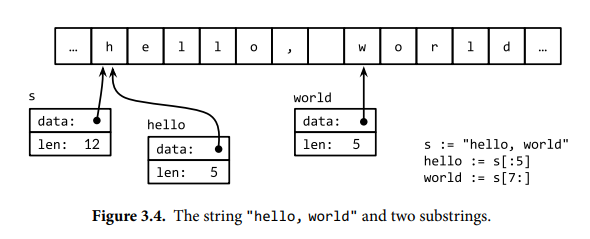
字符串是不可变的字节序列,内置函数 len 返回字符串的字节数量,而不是字符数量,索引操作 s[i] 获取字符串 s 的第 i 个字节。字符串的第 i 个字节不一定就是第 i 个字符,因为非 ASCII 码点的 UTF-8 编码需要多个字节。使用 s[i:j] 可以获取子字符串,该子字符串是一个新的字符串,不过和原串共享底层字节数组。由于可以共享底层内存,所以字符串的复制和子串操作的开销很低。

1
2
3
s := "hello, world"
fmt.Println(len(s)) // "12"
fmt.Println(s[0], s[7]) // "104 119" ('h' and 'w')

可以在字符串中插入转义序列,特别地,有十六进制转义 \xhh 和八进制转义 \ooo,其中 hhooo 表示十六进制和八进制数字,八进制数不超过 \377 对应十进制 255。原始字符串字面量(raw string literal)使用的是反引号而不是单引号,输出时不会处理原始字符串字面量中的转义序列。 例外情况是,当原始字符串字面量跨多行编写时,会删除回车符 \r,从而使字符串在所有平台上保持一致。

1
2
3
4
const GoUsage = `Go is a tool for managing Go source code.
Usage:
go command [arguments]
...`

Unicode

Unicode 是字符编码标准,每个字符对应一个 Unicode 码点,在 Go 中使用 rune 表示(int32 的同义词),即使用 UTF-32 编码方式定长存储 Unicode 码点,但是这样空间开销较大。

UTF-8

UTF-8 变长编码(由 Go 语言开发者发明)使用 1 到 4 字节表示 rune,第一个字节的高位指示当前 rune 使用多少字节表示。变长编码无法直接通过索引访问字符串中的第 n 个字符,但这种编码方式空间有诸多优点。空间占用小,和 ASCII 兼容,自同步(可以通过后退不超过 3 个字节找到字符的开头),从左向右解码不会有歧义。任何字符的编码都不是其他一个或多个字符编码的子串,因此可以通过查找字节来查找字符,而无需担心前面的上下文。字典序和 Unicode 码点顺序相同,不存在嵌入的 NUL 字节(零字节),对于使用 NUL 终止字符串的语言来说非常方便。

Go 的源文件始终使用 UTF-8 编码方式,UTF-8 是 Go 程序处理文本字符串的首选编码方式。可以在字符串中使用 \uhhhh 表示 16 位码点,使用 \Uhhhhhhhh 表示 32 位码点,其中 h 是十六进制数字,每种形式都表示码点的 UTF-8 编码。例如,以下字符串字面量都表示相同的 6 字节字符串。

1
2
3
4
"世界"
"\xe4\xb8\x96\xe7\x95\x8c"
"\u4e16\u754c"
"\U00004e16\U0000754c"

rune 字面量中也可以使用 Unicode 转义字符,下面三种字面量是等价的。对于值小于 256 的 rune 可以使用单个十六进制转义字符表示,例如 '\x41' 表示 'A'。但是更大的值必须使用 \u\U 转义,'\xe4\xb8\x96' 不是合法的 rune 字面量,即使这三个字节是单个码点的 UTF-8 编码。

1
'世' '\u4e16' '\U00004e16'

由于 UTF-8 的特性,许多字符串操作都无需解码。可以使用以下方法检验一个字符串是否是另一个字符串的前缀。

1
2
3
func HasPrefix(s, prefix string) bool {
return len(s) >= len(prefix) && s[:len(prefix)] == prefix
}

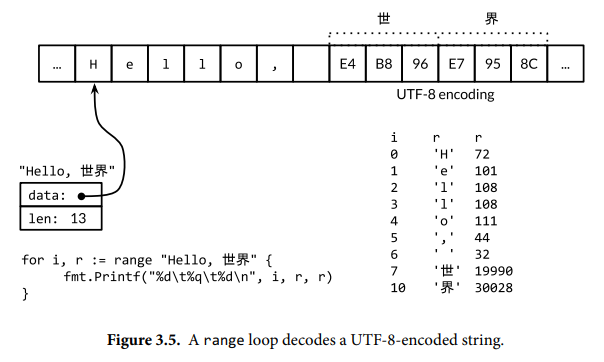
字符串 s 占用 13 个字节,包含 9 个码点/字符/rune,要处理字符可以使用 UTF-8 解码器 DecodeRuneInString。不过 Go 的 range 循环在应用于字符串时会自动进行 UTF-8 解码。

1
2
3
4
5
6
7
8
9
10
11
12
13
s := "Hello, 世界"
fmt.Println(len(s)) // "13"
fmt.Println(utf8.RuneCountInString(s)) // "9"

for i := 0; i < len(s); {
r, size := utf8.DecodeRuneInString(s[i:])
fmt.Printf("%d\t%c\n", i, r)
i += size
}

for i, r := range "Hello, 世界" {
fmt.Printf("%d\t%q\t%d\n", i, r, r)
}

如果 UTF-8 解码遇到非法字节,则会生成特殊的 Unicode 替换字符 \uFFFD,显示为白色问号周围环绕黑色六边形或菱形图案。将 UTF-8 编码的字符串转换为 []rune 之后,会得到 Unicode 码点序列,反之亦然。将整数转换为字符串会将其解释为单个 rune 值,然后将其转换为 UTF-8 表示形式,如果对应的 rune 是无效的,则会使用替换字符。

1
2
3
4
5
// "program" in Japanese katakana
s := "プログラム"
fmt.Printf("% x\n", s) // "e3 83 97 e3 83 ad e3 82 b0 e3 83 a9 e3 83 a0"
r := []rune(s)
fmt.Printf("%x\n", r) // "[30d7 30ed 30b0 30e9 30e0]"

Strings and Byte Slices

字符串 s 可以使用 []byte(s) 转换为字节切片,然后使用 string(b) 转换回来。两个操作通常都会进行复制操作,以确保 b 的可变性和 s2 的不可变性。bytes 包提供 Buffer 类型,类似 Java 中的 StringBuilder,该类型无需初始化,其零值可以直接使用,因为之后调用的方法中会判断底层切片 buf 是否为 nil,然后为其分配内存。

1
2
3
s := "abc"
b := []byte(s)
s2 := string(b)

Conversions between Strings and Numbers

1
2
3
4
5
6
x := 123
y := fmt.Sprintf("%d", x)
fmt.Println(y, strconv.Itoa(x)) // "123 123"

x, err := strconv.Atoi("123") // x is an int
y, err := strconv.ParseInt("123", 10, 64) // base 10, up to 64 bits

Constants

const 常量的底层类型必须是基本类型(和 Java 中的 final 很不一样)。当常量作为一个组声明时,除该组的第一个元素外,剩余元素的右侧表达式可以省略,此时默认会使用之前元素的表达式。

1
2
3
4
5
6
7
const (
a = 1
b
c = 2
d
)
fmt.Println(a, b, c, d) // "1 1 2 2"

The Constant Generator iota

可以使用常量生成器 iota 创建枚举常量组,iota 的值从 0 开始,每次递增 1。

1
2
3
4
5
6
7
8
type Flags uint
const (
FlagUp Flags = 1 << iota // is up
FlagBroadcast // supports broadcast access capability
FlagLoopback // is a loopback interface
FlagPointToPoint // belongs to a point-to-point link
FlagMulticast // supports multicast access capability
)

Untyped Constants

没有指定类型的常量是无类型(untyped)常量,编译器会以比基本类型更高的数值精度来表示无类型常量,并且在其上执行高精度运算而不是机器运算(受限于 CPU 的位数),至少可以假设其具有 256 位精度。例如 ZiBYiB 无法存储在任何整型变量中,但是可以在下面的表达式中使用。有六种无类型常量:untyped boolean、untyped integer、untyped rune、untyped floating-point、untyped complex 和 untyped string。

1
2
3
4
5
6
7
8
9
10
11
12
const (
_ = 1 << (10 * iota)
KiB // 1024
MiB // 1048576
GiB // 1073741824
TiB // 1099511627776 (exceeds 1 << 32)
PiB // 1125899906842624
EiB // 1152921504606846976
ZiB // 1180591620717411303424 (exceeds 1 << 64)
YiB // 1208925819614629174706176
)
fmt.Println(YiB/ZiB) // "1024"

浮点型常量 math.Pi 可以在需要浮点或复数的情况下使用,但是如果为其指定类型 float64,则精度会降低,而且在需要使用 float32complex128 类型的值时需要显式类型转换。

1
2
3
4
5
6
7
8
var x float32 = math.Pi
var y float64 = math.Pi
var z complex128 = math.Pi

const Pi64 float64 = math.Pi
var x float32 = float32(Pi64)
var y float64 = Pi64
var z complex128 = complex128(Pi64)

只有常量可以不指定类型,当将无类型常量赋值给变量时,该常量会隐式转换为变量的类型。

1
2
3
4
var f float64 = 3 + 0i // untyped complex -> float64
f = 2 // untyped integer -> float64
f = 1e123 // untyped floating-point -> float64
f = 'a' // untyped rune -> float64

无论隐式还是显式转换,在转换时目标类型必须能够表示原始值,对于实数和复数的浮点数,允许四舍五入。

1
2
3
4
5
6
7
8
9
const (
deadbeef = 0xdeadbeef // untyped int with value 3735928559
a = uint32(deadbeef) // uint32 with value 3735928559
b = float32(deadbeef) // float32 with value 3735928576 (rounded up)
c = float64(deadbeef) // float64 with value 3735928559 (exact)
d = int32(deadbeef) // compile error: constant overflows int32
e = float64(1e309) // compile error: constant overflows float64
f = uint(-1) // compile error: constant underflows uint
)

在未显式指定类型的变量声明中,无类型常量的特性会决定变量的默认类型。无类型整型默认转换为 int 类型,无类型浮点数和复数默认转换为 float64complex128。如果要使用其他类型,需要显示类型转换,或者在变量声明中指定类型。在将无类型常量转换为接口值时,默认值非常重要,因为它们会决定接口的动态类型。

1
2
3
4
i := 0      // untyped integer; implicit int(0)
r := '\000' // untyped rune; implicit rune('\000')
f := 0.0 // untyped floating-point; implicit float64(0.0)
c := 0i // untyped complex; implicit complex128(0i)
1
2
3
4
fmt.Printf("%T\n", 0)      // "int"
fmt.Printf("%T\n", 0.0) // "float64"
fmt.Printf("%T\n", 0i) // "complex128"
fmt.Printf("%T\n", '\000') // "int32" (rune)

Composite Types

Arrays

数组元素默认初始化为元素类型的零值,可以使用数组字面量(array literal)来初始化数组。在数组字面量中,如果使用省略号 ... 代替数组长度,则数组长度就是列表中元素的数量。数组大小属于类型的一部分,[3]int[4]int 是不同的类型。大小必须是一个常量表达式,在编译时能够确定值。

1
2
3
var a [3]int // array of 3 integers
fmt.Println(a[0]) // print the first element
fmt.Println(a[len(a)-1]) // print the last element, a[2]
1
2
3
var q [3]int = [3]int{1, 2, 3}
var r [3]int = [3]int{1, 2}
fmt.Println(r[2]) // "0"
1
2
q := [...]int{1, 2, 3}
fmt.Printf("%T\n", q) // "[3]int"

除指定值列表外,还可以指定索引和值构成的列表,索引可以按任意顺序排列,不需要列出所有索引,未指定值的索引默认取零值。下面的数组 r 包含 100 个元素,其中最后一个元素的值为 -1。如果数组元素是可比较的,那么相同数组类型之间也可以相互比较,只有当所有对应元素都相等时,两个数组才相等。

1
r := [...]int{99: -1}

将数组作为参数传递时,传递的是数组的副本,如果函数想要修改原数组,需要传递指向数组的指针。

1
2
3
func zero(ptr *[32]byte) {
*ptr = [32]byte{}
}

Slices

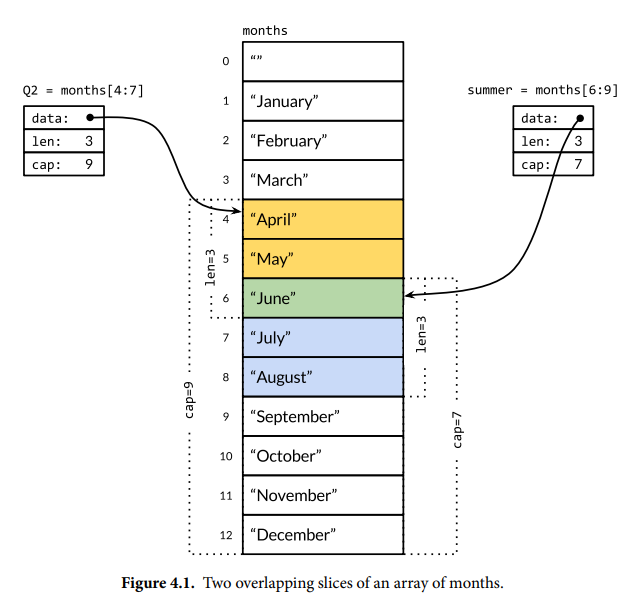
切片是可变长的序列,由指针、长度和容量组成。指针指向该切片能够访问的底层数组的第一个元素,该元素不一定是底层数组的第一个元素。长度是切片包含的元素数量,容量是切片起始位置到底层数组末尾之间的元素数量,长度不会超过容量。多个切片可以共享相同的底层数组。

1
2
3
4
5
months := [...]string{1: "January", /* ... */, 12: "December"}
Q2 := months[4:7]
summer := months[6:9]
fmt.Println(Q2) // ["April" "May" "June"]
fmt.Println(summer) // ["June" "July" "August"]

超出切片容量 cap(s) 会导致 panic,超出长度 len(s) 会扩展切片长度。由于切片包含指向底层数组的指针,所以将其作为参数传递不会复制数组元素,参数和切片共享底层数组。

1
2
3
fmt.Println(summer[:20]) // panic: out of range
endlessSummer := summer[:5] // extend a slice (within capacity)
fmt.Println(endlessSummer) // "[June July August September October]"

切片字面量和数组字面量类似,只是未给出大小,它会先创建具有正确大小的数组,然后将该数组作为切片的底层数组。

1
s := []int{0, 1, 2, 3, 4, 5}

和数组不同,切片无法进行比较,不能使用 == 判断两个切片是否相等。标准库提供对 []byte 切片的比较函数 bytes.Equal,对于其他类型的切片,需要自己实现比较逻辑。例外情况是,切片可以和 nil 进行比较。

1
if summer == nil { /* ... */ }

切片的零值是 nilnil 切片的长度和容量都是零。不过长度和容量为零的切片不一定是 nil 切片,例如 []int{}make([]int, 3)[3:]。除和 nil 进行相等性比较之外,nil 切片和任何其他长度为零的切片具有相同的行为。

1
2
3
4
var s []int    // len(s) == 0, s == nil
s = nil // len(s) == 0, s == nil
s = []int(nil) // len(s) == 0, s == nil
s = []int{} // len(s) == 0, s != nil

内置函数 make 用于创建切片,如果省略容量参数,则容量默认和长度相等。内部实现上,make 会创建未命名的数组变量,然后返回该数组的一个切片,该数组只能通过切片访问。

1
2
make([]T, len)
make([]T, len, cap) // same as make([]T, cap)[:len]

The append Function

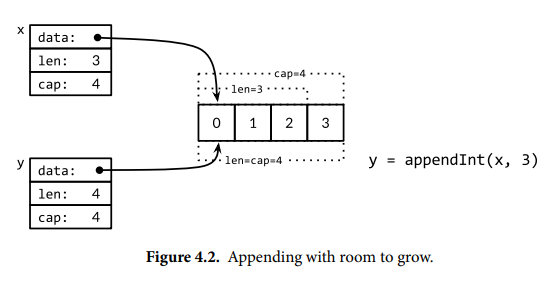
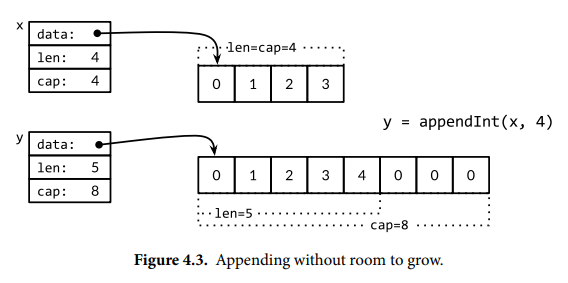
内置函数 append 将元素添加到切片。如果容量足够则扩展切片长度,这会返回一个更大的新切片,和原切片共享底层数组。如果容量不足,则需要创建新数组,将旧数组的元素复制到新数组,此时和原切片的底层数组不同。下面是一个简易实现示例,内置函数 append 可能更加复杂。

1
2
3
4
5
6
7
8
9
10
11
12
13
14
15
16
17
18
19
func appendInt(x []int, y int) []int {
var z []int
zlen := len(x) + 1
if zlen <= cap(x) {
// There is room to grow. Extend the slice.
z = x[:zlen]
} else {
// There is insufficient space. Allocate a new array.
// Grow by doubling, for amortized linear complexity.
zcap := zlen
if zcap < 2*len(x) {
zcap = 2 * len(x)
}
z = make([]int, zlen, zcap)
copy(z, x) // a built-in function; see text
}
z[len(x)] = y
return z
}

内置的 append 函数允许添加多个元素或切片,省略号 ...int 表示函数具有可变参数,在切片之后添加省略号表示将其展开为参数列表。

1
2
3
4
5
6
var x []int
x = append(x, 1)
x = append(x, 2, 3)
x = append(x, 4, 5, 6)
x = append(x, x...) // append the slice x
fmt.Println(x) // "[1 2 3 4 5 6 1 2 3 4 5 6]"

Maps

map 是对哈希表的引用,表示为 map[K]V,其中 KV 分别是键值的类型。键类型必须能够使用 == 比较,不建议使用浮点数作为键,因为浮点数可以是 NaN。可以使用内置函数 make 或哈希表字面量(map literal)创建 map,使用内置函数 delete 删除键。如果键不在哈希表中,则会返回值类型对应的零值。

1
2
3
4
5
6
7
ages := map[string]int{
"alice": 31,
"charlie": 34,
}
ages["alice"] = 32
fmt.Println(ages["alice"]) // "32"
delete(ages, "alice") // remove element ages["alice"]

map 元素不是变量,无法获取其地址,原因之一是扩容会导致地址失效。

1
_ = &ages["bob"] // compile error: cannot take address of map element

可以使用基于范围的 for 循环遍历哈希表。map 的迭代顺序不是确定性的,实际实现为随机顺序,如果要按照顺序遍历,需要对键进行排序。由于已知 names 的最终大小,所以预分配指定容量的数组会更高效。

1
2
3
4
5
6
7
8
names := make([]string, 0, len(ages))
for name := range ages {
names = append(names, name)
}
sort.Strings(names)
for _, name := range names {
fmt.Printf("%s\t%d\n", name, ages[name])
}

map 类型的零值是 nil,表示没有引用哈希表。对 nil 映射执行 []deletelenrange 都是安全的,其行为和空映射 map[string]int{} 类似。但是不允许向其中存储数据,会导致程序崩溃。

1
2
3
4
var ages map[string]int
fmt.Println(ages == nil) // "true"
fmt.Println(len(ages) == 0) // "true"
ages["carol"] = 21 // panic: assignment to entry in nil map

可以使用以下形式判断 map 中是否存在指定的键,以和默认零值区分开来。和切片类似,map 之间不能相互比较,只允许其和 nil 进行比较。如果想要将切片作为键,由于切片是不可比较的,所以可以将切片转换为字符串。

1
if age, ok := ages["bob"]; !ok { /* ... */ }

Structs

使用 type xxx struct 形式声明结构体,指向结构体的指针可以直接通过 . 访问其字段(不像 C++ 需要使用 ->),该写法等价于显式解引用之后再使用 .。字段通常一行写一个,不过相同类型的连续字段可以合并书写。字段顺序对于类型标识至关重要,不同字段顺序定义得到的是不同的类型。如果字段名称以大写开头,则该字段会被导出。

1
2
3
4
5
6
7
8
type Employee struct {
ID int
Name, Address string
DoB time.Time
Position string
Salary int
ManagerID int
}
1
2
3
var employeeOfTheMonth *Employee = &dilbert
employeeOfTheMonth.Position += " (proactive team player)"
(*employeeOfTheMonth).Position += " (proactive team player)"

具有名称 S 的结构体不能声明类型为 S 的字段,即不能包含自身类型的字段,但是可以包含指向自身类型的指针。结构体的零值由其每个字段的零值组合而成。没有字段的结构体 struct{} 被称为空结构体,其大小为零,可以用作 map[string]struct{}{} 表示集合类型。

Struct Literals

可以使用结构体字面量(struct literal)初始化结构体,如果不指定类型,需要按照字段声明顺序,给所有字段指定初始值。如果指定类型,则可以随意指定某些字段的初始值,剩余字段默认初始化为零值。结构体作为参数传递使用的是值传递,可以仅传递指针来提高效率。两种形式不能在相同字面量中混合使用。

Comparing Structs

如果结构体的所有字段都是可比较的,那么该结构体就是可比较的,因此可以使用 ==!= 进行比较。和其他可比较类型类似,可比较的结构体也可以作为 map 的键。

Struct Embedding and Anonymous Fields

可以使用结构体嵌入(struct embedding)将一个结构体作为另一个结构体的匿名字段,从而允许将形如 x.d.e.f 的字段链简化为 x.f。Go 中使用组合而不是继承复用代码,结构体嵌入可以简化组合产生的过长字段链。由于匿名字段实际上有隐含的名称,所有不能有两个相同类型的匿名字段,因为它们会相互冲突。

1
2
3
4
5
6
7
8
9
10
11
12
13
14
15
16
17
type Point struct {
X, Y int
}
type Circle struct {
Point
Radius int
}
type Wheel struct {
Circle
Spokes int
}

var w Wheel
w.X = 8 // equivalent to w.Circle.Point.X = 8
w.Y = 8 // equivalent to w.Circle.Point.Y = 8
w.Radius = 5 // equivalent to w.Circle.Radius = 5
w.Spokes = 20

JSON

将 Go 数据结构序列化为 JSON 字符串,可以使用 json.Marshal 函数。序列化会将 Go 结构体字段名称用作 JSON 对象的字段名称,只有导出的字段才会被序列化。通过定义适当的数据结构,在反序列化时可以获取指定的数据,其余数据将被忽略。可以使用字段标签(field tags)替换 JSON 中默认的字段名称,使用 key:"value" 形式声明字段标签。字段标签通常用于将 Go 字段的驼峰命名转换为 JSON 字段的下划线命名,可以使用 omitempty 表示字段为零值或者为空时不生成对应的 JSON 输出。

1
2
3
4
5
6
7
8
9
10
11
12
13
14
15
16
17
18
19
20
21
22
23
24
25
26
27
28
29
30
31
32
33
34
35
36
37
38
39
40
41
42
43
44
45
46
type Movie struct {
Title string
Year int `json:"released"`
Color bool `json:"color,omitempty"`
Actors []string
}

var movies = []Movie{
{Title: "Casablanca", Year: 1942, Color: false,
Actors: []string{"Humphrey Bogart", "Ingrid Bergman"}},
{Title: "Cool Hand Luke", Year: 1967, Color: true,
Actors: []string{"Paul Newman"}},
{Title: "Bullitt", Year: 1968, Color: true,
Actors: []string{"Steve McQueen", "Jacqueline Bisset"}},
// ...
}

func main() {
{
//!+Marshal
data, err := json.Marshal(movies)
if err != nil {
log.Fatalf("JSON marshaling failed: %s", err)
}
fmt.Printf("%s\n", data)
//!-Marshal
}

{
//!+MarshalIndent
data, err := json.MarshalIndent(movies, "", " ")
if err != nil {
log.Fatalf("JSON marshaling failed: %s", err)
}
fmt.Printf("%s\n", data)
//!-MarshalIndent

//!+Unmarshal
var titles []struct{ Title string }
if err := json.Unmarshal(data, &titles); err != nil {
log.Fatalf("JSON unmarshaling failed: %s", err)
}
fmt.Println(titles) // "[{Casablanca} {Cool Hand Luke} {Bullitt}]"
//!-Unmarshal
}
}

Functions

Function Declarations

函数声明包含名称、参数列表、返回值列表以及函数体。如果函数值返回单个未命名返回值或者没有返回值,则可以省略返回值列表的括号。可以给返回值命名,此时默认会为每个名称声明对应的局部变量,初始化为其类型的零值。有返回值列表的函数必须以 return 语句结束,除非程序不会到达函数末尾。

1
2
3
func name(parameter-list) (result-list) {
body
}

相同类型的参数可以分为一组,仅编写一次类型。空标识 _ 表示参数未被使用。函数的类型有时被称为其签名(signature),如果两个函数具有相同的参数类型和返回值类型,那么它们就具有相同的签名。参数和返回值的名称不会影响签名,签名也不受分组形式声明的影响。

1
2
3
4
5
6
7
8
9
func add(x int, y int) int { return x + y }
func sub(x, y int) (z int) { z = x - y; return }
func first(x int, _ int) int { return x }
func zero(int, int) int { return 0 }

fmt.Printf("%T\n", add) // "func(int, int) int"
fmt.Printf("%T\n", sub) // "func(int, int) int"
fmt.Printf("%T\n", first) // "func(int, int) int"
fmt.Printf("%T\n", zero) // "func(int, int) int"

参数总是值传递的,函数会接受参数的副本,对副本进行修改不会影响调用者。当参数是引用类型时,函数可以修改该参数间接引用的变量。如果发现某个函数没有函数体,则说明该函数是使用其他语言编写的。

1
func Sin(x float64) float64 // implemented in assembly language

Recursion

许多编程语言使用固定大小的函数栈,通常为 64KB 到 2MB之间。固定大小的函数栈会限制递归调用的深度,需要小心避免栈溢出。Go 使用可变大小的栈,初始较小然后根据需要增大,直至达到大约 1GB 的上限。

Multiple Return Values

Go 语言的垃圾回收机制会回收未使用的内存,但它不会自动释放未使用的操作系统资源,比如打开的文件和网络连接,这些资源应当显式的关闭。具有命名返回值的函数可以省略 return 语句的操作数,这被称为裸返回(bare return)。

1
2
3
func Size(rect image.Rectangle) (width, height int)
func Split(path string) (dir, file string)
func HourMinSec(t time.Time) (hour, minute, second int)

Errors

对于失败(failure)是预期行为的函数,通常会有额外的返回值。如果失败的原因只有一个,那么额外返回布尔类型,否则应该返回 error 类型。内置类型 error 是接口类型,为 nil 时表示成功,反之则表示失败。和其他使用异常机制的语言不同,Go 语言使用 panic 表示非预期的错误,预期错误则使用 ifreturn 控制流机制实现错误处理。

Error-Handling Strategies

当函数调用出现错误时,调用方有责任检查并采取相应措施。最常见的处理方式是传播错误,也可以为错误添加额外信息。因为错误通常是链式的,所以消息字符串不应该大小,也不应该使用换行符。通常函数 f(x) 负责报告所执行的操作 f 以及与错误相关的参数 x,而调用者负责补充 f(x) 没有的其它信息。

1
2
3
4
5
6
7
8
9
10
resp, err := http.Get(url)
if err != nil {
return nil, err
}

doc, err := html.Parse(resp.Body)
resp.Body.Close()
if err != nil {
return nil, fmt.Errorf("parsing %s as HTML: %v", url, err)
}

另一种错误处理方式是重试,需要设置重试次数和重试前的等待时间。如果无法取得进展,调用者可以打印错误信息并终止程序,但这种处理方式仅用于程序的主要模块中。库函数通常应该将错误信息传递给调用者,除非该错误是 BUG。在某些情况下,可以仅记录错误信息并继续运行。极少数情况下,可以完全忽略某个错误。

End of File (EOF)

文件结束条件会产生 io.EOF 错误,需要特殊处理该错误。

1
2
3
4
5
6
7
8
9
10
11
in := bufio.NewReader(os.Stdin)
for {
r, _, err := in.ReadRune()
if err == io.EOF {
break // finished reading
}
if err != nil {
return fmt.Errorf("read failed: %v", err)
}
// ...use r...
}

Function Values

在 Go 语言中,函数是一等公民(first-class values),像其他值一样,函数值也有类型,也可以作为参数传递给函数或从函数返回。函数类型的零值是 nil,调用 nil 函数会导致 panic,函数值之间是不可比较的,只能和 nil 比较。

1
2
3
4
5
6
7
8
9
10
11
12
func square(n int) int     { return n * n }
func negative(n int) int { return -n }
func product(m, n int) int { return m * n }

f := square
fmt.Println(f(3)) // "9"

f = negative
fmt.Println(f(3)) // "-3"
fmt.Printf("%T\n", f) // "func(int) int"

f = product // compile error: can't assign f(int, int) int to f(int) int

Anonymous Functions

命名函数只能在包级进行声明,而匿名函数可以在任意表达式中使用。每次调用 squares 都会创建一个局部变量 x,并返回一个类型为 func() int 的匿名函数。此时,匿名函数可以访问和修改外层函数的局部变量 x。这些隐含的变量就是将函数视为引用类型,以及函数值之间无法比较的原因。这类函数值使用闭包(closures)技术实现。就像之前提到的返回局部变量的地址的例子,闭包示例也说明变量的生命周期不是由作用域决定,而是由可达性决定。

1
2
3
4
5
6
7
8
9
10
11
12
13
14
15
16
17
// squares returns a function that returns
// the next square number each time it is called.
func squares() func() int {
var x int
return func() int {
x++
return x * x
}
}

func main() {
f := squares()
fmt.Println(f()) // "1"
fmt.Println(f()) // "4"
fmt.Println(f()) // "9"
fmt.Println(f()) // "16"
}

当匿名函数需要递归时,必须先声明一个变量,然后将匿名函数赋值给该变量。

1
2
3
4
5
visitAll := func(items []string) {
// ...
visitAll(m[item]) // compile error: undefined: visitAll
// ...
}

Caveat: Capturing Iteration Variables

在迭代中使用匿名函数时,需要避免捕获迭代变量的陷阱,正确的做法是声明一个同名的局部变量覆盖迭代变量。

1
2
3
4
5
6
7
8
var rmdirs []func()
dirs := tempDirs()
for i := 0; i < len(dirs); i++ {
os.MkdirAll(dirs[i], 0755) // OK
rmdirs = append(rmdirs, func() {
os.RemoveAll(dirs[i]) // NOTE: incorrect!
})
}

Variadic Functions

可变参函数的最后一个参数类型前面使用省略号 ...,表示可以接收任意数量的该类型参数。实际上,调用者会创建一个数组,将参数赋值到其中,然后将数组的切片传递给函数。

1
2
3
4
5
6
7
func sum(vals ...int) int {
total := 0
for _, val := range vals {
total += val
}
return total
}

尽管 ...int 参数的行为类似切片,但是可变参函数的类型和带有切片参数函数的类型并不相同。

1
2
3
4
5
func f(...int) {}
func g([]int) {}

fmt.Printf("%T\n", f) // "func(...int)"
fmt.Printf("%T\n", g) // "func([]int)"

Deferred Function Calls

defer 关键字之后跟函数调用,表示延迟执行该调用。函数和参数表达式在执行该语句时就会被计算,而实际调用则会推迟到包含该 defer 语句的函数执行完毕时,无论函数是正常/异常结束。可以有任意数量的调用被延迟执行,它们会以执行 defer 语句相反的顺序依次执行(类似栈 LIFO)。

1
2
3
4
5
6
7
8
var mu sync.Mutex
var m = make(map[string]int)

func lookup(key string) int {
mu.Lock()
defer mu.Unlock()
return m[key]
}

可以在单个 defer 语句中,对函数的入口和出口进行检测。下面的 trace 函数会立即被调用,而其返回的函数在 bigSlowOperation 函数结束时被调用。

1
2
3
4
5
6
7
8
9
10
11
func bigSlowOperation() {
defer trace("bigSlowOperation")() // don't forget the extra parentheses
// ...lots of work...
time.Sleep(10 * time.Second) // simulate slow operation by sleeping
}

func trace(msg string) func() {
start := time.Now()
log.Printf("enter %s", msg)
return func() { log.Printf("exit %s (%s)", msg, time.Since(start)) }
}

延迟执行的函数在 return 语句更新完返回值变量之后执行,可以在其中修改返回值。

1
2
3
4
5
6
func triple(x int) (result int) {
defer func() { result += x }()
return double(x)
}

fmt.Println(triple(4)) // "12"

Panic

当 Go 运行时检测到严重的错误时,会产生 panic,正常执行会停止,从函数栈顶到 main 函数的所有延迟函数调用会依次执行,然后程序会崩溃并记录日志。可以显示调用内置的 painc 函数。对于函数的前置条件进行确认是良好的做法,但是除非能够提供更详细的错误信息或更早地检测到错误,否则没有必要去确认在运行时会自动检查的条件。

1
2
3
4
5
6
func Reset(x *Buffer) {
if x == nil {
panic("x is nil") // unnecessary!
}
x.elements = nil
}

Recover

如果在延迟函数中调用内置的 recover 函数,且包含该 defer 语句的函数发生 panic,那么 recover 会终止当前的 panic 状态并返回 panic 的值。发生 panic 的函数不会继续执行,而是直接返回。在没有发生 panic 时调用 recover 函数不会有任何效果,仅仅返回 nil

1
2
3
4
5
6
7
8
func Parse(input string) (s *Syntax, err error) {
defer func() {
if p := recover(); p != nil {
err = fmt.Errorf("internal error: %v", p)
}
}()
// ...parser...
}

Methods

Method Declarations

方法声明就是在函数名之前添加额外的参数,该参数将函数和该参数的类型绑定。额外的参数 p 被称作该方法的接收者(receiver),在 Go 语言中,没有使用 thisself 表示接收者,而是像对待普通参数一样选择接收者的名称,通常使用类型的首字母作为其名称。以下两个函数声明不会相互冲突,一个是包级函数,另一个是 Point 类型的方法。

在 Go 语言中,字段和方法不能同名(和 Java 不同)。和其他面向对象语言不同,Go 中可以为大多数类型定义方法,而不仅仅是结构体类型。例外情况是:① 不能直接为基本类型定义方法,而必须使用 type 创建命名类型;② 不能为指针和接口类型定义方法,但是接收者可以是指向非指针类型的指针。另外,类型和方法必须定义在相同的包中。

1
2
3
4
5
6
7
8
9
10
11
type Point struct{ X, Y float64 }

// traditional function
func Distance(p, q Point) float64 {
return math.Hypot(q.X-p.X, q.Y-p.Y)
}

// same thing, but as a method of the Point type
func (p Point) Distance(q Point) float64 {
return math.Hypot(q.X-p.X, q.Y-p.Y)
}

Methods with a Pointer Receiver

如果方法使用 (p Point) 声明,则和普通参数一样会复制该变量,如果想要在方法中修改相关变量,则应该使用 (p *Point) 指针类型接收变量的地址。在调用时也需要通过指针调用该方法,不过语法上允许直接通过 Point 变量而不是 *Point 调用 ScaleBy 方法,编译器会对其隐式地执行 & 取址操作。对于临时值由于还没有为其分配地址,所以不能使用简写形式。同样可以通过 *Point 变量调用 Distance 方法,编译器会隐式地执行 * 解引用操作。

1
2
3
4
5
6
7
8
func (p *Point) ScaleBy(factor float64) {
p.X *= factor
p.Y *= factor
}

r := &Point{1, 2}
r.ScaleBy(2)
fmt.Println(*r) // "{2, 4}"
1
Point{1, 2}.ScaleBy(2) // compile error: can't take address of Point literal

Nil Is a Valid Receiver Value

正如函数允许将 nil 指针作为参数,接收者也可以为 nil,当 nil 是该类型有意义的零值时。

1
2
3
4
5
6
7
8
9
10
11
12
13
14
// An IntList is a linked list of integers.
// A nil *IntList represents the empty list.
type IntList struct {
Value int
Tail *IntList
}

// Sum returns the sum of the list elements.
func (list *IntList) Sum() int {
if list == nil {
return 0
}
return list.Value + list.Tail.Sum()
}

Composing Types by Struct Embedding

结构体嵌入会将内部组合结构体的方法提升到外部结构体中。这种组合方式和继承不同,两种类型并不是父子关系,不具有多态性。实际上,编译器会生成包装方法,其内部会调用字段的对应方法。

1
2
3
4
5
6
7
8
9
10
11
12
13
type ColoredPoint struct {
Point
Color color.RGBA
}

red := color.RGBA{255, 0, 0, 255}
blue := color.RGBA{0, 0, 255, 255}
var p = ColoredPoint{Point{1, 1}, red}
var q = ColoredPoint{Point{5, 4}, blue}
fmt.Println(p.Distance(q.Point)) // "5"
p.ScaleBy(2)
q.ScaleBy(2)
fmt.Println(p.Distance(q.Point)) // "10"
1
2
3
4
5
6
func (p ColoredPoint) Distance(q Point) float64 {
return p.Point.Distance(q)
}
func (p *ColoredPoint) ScaleBy(factor float64) {
p.Point.ScaleBy(factor)
}

Method Values and Expressions

1
2
3
4
5
6
7
8
9
10
11
12
p := Point{1, 2}
q := Point{4, 6}

distanceFromP := p.Distance // method value
fmt.Println(distanceFromP(q)) // "5"
var origin Point // {0, 0}
fmt.Println(distanceFromP(origin)) // "2.23606797749979", ;5

scaleP := p.ScaleBy // method value
scaleP(2) // p becomes (2, 4)
scaleP(3) // then (6, 12)
scaleP(10) // then (60, 120)
1
2
3
4
5
6
7
8
9
10
11
p := Point{1, 2}
q := Point{4, 6}

distance := Point.Distance // method expression
fmt.Println(distance(p, q)) // "5"
fmt.Printf("%T\n", distance) // "func(Point, Point) float64"

scale := (*Point).ScaleBy
scale(&p, 2)
fmt.Println(p) // "{2 4}"
fmt.Printf("%T\n", scale) // "func(*Point, float64)"

Interfaces

Interface Satisfaction

接口类型是抽象类型,其定义一组方法,只要具体类型有这些方法,就可以被视为该接口的实例(隐式实现接口)。接口类型之间也可以嵌入,使得当前接口具有另一个接口的方法,而不需要显示的全部定义出来。只要具体类型或接口类型有某个接口类型的所有方法,就可以将其赋值给该接口类型。可以将任何值赋值给空接口类型 interface{}。可以使用以下方式,在编译时断言 bytes.Buffer 类型满足 io.Writer 接口。

1
2
3
4
5
6
var any interface{}
any = true
any = 12.34
any = "hello"
any = map[string]int{"one": 1}
any = new(bytes.Buffer)
1
2
3
// *bytes.Buffer must satisfy io.Writer
var w io.Writer = new(bytes.Buffer)
var _ io.Writer = (*bytes.Buffer)(nil)

Interface Values

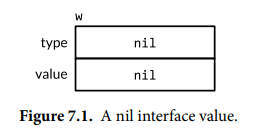
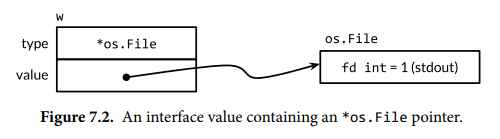
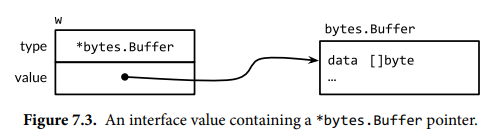
接口类型的值(interface value)包含两个组成部分,即具体类型以及该类型的值,它们被称为动态类型(dynamic type)和动态值(dynamic value)。动态类型由类型描述符(type descriptor)表示,其提供类型的字段和方法信息。接口的零值,其类型和值的组成部分都被设置为 nil。如果接口的类型部分是 nil,则该接口值就是 nil

1
2
3
4
5
6
7
8
var w io.Writer
fmt.Printf("%T\n", w) // "<nil>"

w = os.Stdout
fmt.Printf("%T\n", w) // "*os.File"

w = new(bytes.Buffer)
fmt.Printf("%T\n", w) // "*bytes.Buffer"

可以使用 ==!= 比较接口值,如果两个接口值均为 nil,或者它们的动态类型和动态值都相同,则这两个接口值相同。如果两个接口值的动态类型相同,但是它们的动态类型不支持比较操作,则会引发 panic

1
2
var x interface{} = []int{1, 2, 3}
fmt.Println(x == x) // panic: comparing uncomparable type []int

Caveat: An Interface Containing a Nil Pointer Is Non-Nil

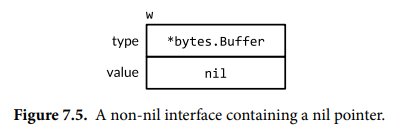
debug = false 时,下面的代码会引发 panic,因为接口值的动态类型不是 nil,而动态值是 nil,在调用 (*bytes.Buffer).Write 方法时会出问题。解决方案是,将 buf 声明为 var buf io.Writer,避免将无效值(bytes.Buffer 类型的 nil 指针)赋值给接口类型。

1
2
3
4
5
6
7
8
9
10
11
12
13
14
15
16
17
18
19
20
const debug = true

func main() {
var buf *bytes.Buffer
if debug {
buf = new(bytes.Buffer) // enable collection of output
}
f(buf) // NOTE: subtly incorrect!
if debug {
// ...use buf...
}
}

// If out is non-nil, output will be written to it.
func f(out io.Writer) {
// ...do something...
if out != nil {
out.Write([]byte("done!\n")) // panic: nil pointer dereference
}
}

Type Assertions

类型断言(type assertion)是对接口值执行的操作,形如 x.(T),其中 x 是接口类型的表达式,T 是断言类型。如果 T 是具体类型,那么类型断言会检查 x 的动态类型是否和 T 相同,如果相同则返回 x 的动态值,否则引发 panic

1
2
3
4
var w io.Writer
w = os.Stdout
f := w.(*os.File) // success: f == os.Stdout
c := w.(*bytes.Buffer) // panic: interface holds *os.File, not *bytes.Buffer

如果 T 是接口类型,那么类型断言会检查 x 的动态类型是否满足 T,如果满足则返回类型为 T 的接口值,该接口值和 x 具有相同的动态类型和动态值。不论 T 是什么类型,如果 xnil,则断言会失败。

1
2
3
4
5
var w io.Writer
w = os.Stdout
rw := w.(io.ReadWriter) // success: *os.File has both Read and Write
w = new(ByteCounter)
rw = w.(io.ReadWriter) // panic: *ByteCounter has no Read method

如果使用以下类型断言方式,则断言失败不会引发 panic,而是额外返回 false

1
2
3
var w io.Writer = os.Stdout
f, ok := w.(*os.File) // success: ok, f == os.Stdout
b, ok := w.(*bytes.Buffer) // failure: !ok, b == nil

Type Switches

1
2
3
4
5
6
7
8
9
10
11
12
13
14
15
16
17
func sqlQuote(x interface{}) string {
switch x := x.(type) {
case nil:
return "NULL"
case int, uint:
return fmt.Sprintf("%d", x) // x has type interface{} here.
case bool:
if x {
return "TRUE"
}
return "FALSE"
case string:
return sqlQuoteString(x) // (not shown)
default:
panic(fmt.Sprintf("unexpected type %T: %v", x, x))
}
}
作者

Ligh0x74

发布于

2024-01-01

更新于

2025-06-09

许可协议

评论